
Ori and the Will of the Wisps map: Niwen Interactive Tools
Use Niwen’s interactive map to organize collectibles, locate structures, and plan routes with filters, custom markers, and language options.
Jump to

Find the Information You Need Without the Clutter
An Ori and the Will of the Wisps map becomes easier to read when you focus on the icons that answer your current question. That matters because collectible locations, structures, and landmarks can compete for your attention when you view them together. This guide explains how to use the Ori and the Will of the Wisps map as a focused reference for exploration and route planning.
The Niwen interactive map provides categories for collectibles, structures, Lupo, and Wisps. Its menu also lists custom markers, a route tool, language choices, and a location-sharing option. Those features give you several ways to organize what you want to investigate.
A good approach is to begin with a specific question: Are you looking for a particular collectible category, checking a structure, or organizing locations to revisit? Let that question determine which information you display.
Understand what the map can tell you
The supplied reference documents the map’s menu and available categories. It does not include individual marker descriptions, exact coordinates, access requirements, or directions through particular areas.
Use the map to identify locations for further inspection. A marker’s presence alone does not establish how to reach it or what conditions apply there.
Before examining a dense cluster of symbols, decide what would make your current map check useful. Finding a relevant category, identifying a landmark, or recording an unanswered question gives your search a clear purpose.
Filter Collectibles Around a Specific Goal
The collectible menu is a useful starting point for an Ori and the Will of the Wisps map search. It separates several item types instead of presenting them as a single undifferentiated group.
 Image: Steam / Moon Studios GmbH
That distinction matters when your question is narrow. If you want to examine Gorlek Ore locations, unrelated collectible icons may add visual noise. A good approach is to focus on the matching category, then broaden your view if nearby information becomes relevant.
The reference lists these collectible categories:
| Collectible category | Information represented by the category | Suggested focus |
|---|---|---|
| Spirit Light | Locations labeled as Spirit Light | Review this category when Spirit Light is your map-search target |
| Energy Cells | Locations labeled as Energy Cells | Keep these distinct from Life Cells while inspecting the map |
| Life Cells | Locations labeled as Life Cells | Use the category to focus a Life Cell search |
| Gorlek Ore | Locations labeled as Gorlek Ore | Examine ore markers without mixing them with unrelated items |
| Skills | Locations grouped under Skills | Identify entries to investigate without assuming access requirements |
| Spirit Shards | Locations grouped under Spirit Shards | Keep shard searches separate from the Skills category |
| Keystones | Locations labeled as Keystones | Inspect these markers without assuming a connection to a particular gate |
| Seeds | Locations labeled as Seeds | Focus your review on seed entries |
| Other | Collectible entries grouped under Other | Check this category when the named filters do not answer your question |
These are map categories, not explanations of item effects. The supplied menu does not describe what each collectible does, how it is obtained, or whether it requires another action.
Keep similar labels separate
Skills and Spirit Shards have separate entries in the menu. Energy Cells and Life Cells do, too. Preserve those distinctions when searching or taking notes.
A useful note might read, “Check the Spirit Shards category in this area.” That is more precise than “Look for upgrades,” which could refer to several different filters.
Likewise, a Keystones marker does not, by itself, document a relationship with a nearby Spirit Gate. If that relationship matters to your route, treat it as a question to verify rather than a conclusion drawn from proximity.
Broaden the view when you need context
The menu includes an option for viewing all categories. A good approach is to use that broader view when you want to understand how different types of markers sit near one another.
Then narrow your focus again when a specific symbol becomes difficult to distinguish.
For example, you might examine Seeds on their own, then include structures to give your search additional landmarks. This is an organizational technique based on the available categories; it does not establish that the locations are connected by a traversable path.
The value of an Ori and the Will of the Wisps map comes partly from choosing what to inspect, rather than keeping every possible symbol visible throughout your search.
Use Structures and Landmarks to Add Context
Collectible markers answer item-focused questions. Structure and landmark categories provide a different way to orient your map review.
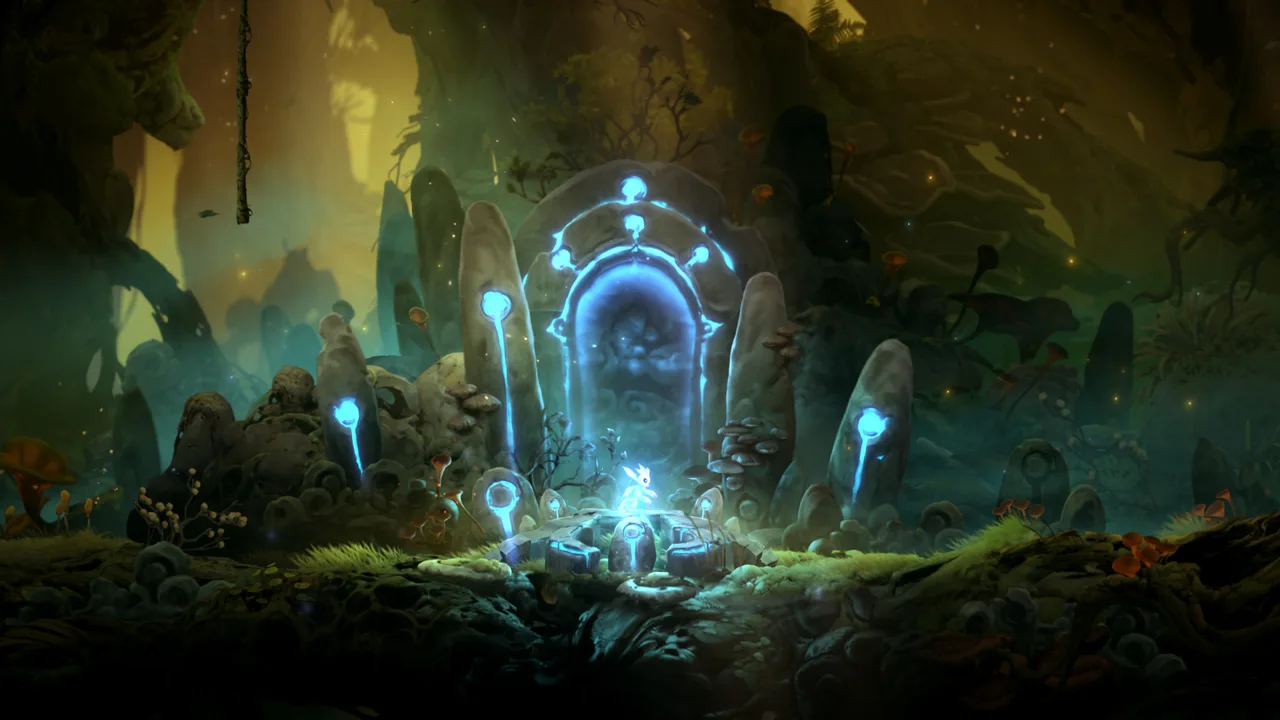 Image: Steam / Moon Studios GmbH
The Niwen map lists Spirit Wells, Spirit Gates, Spirit Trials, and Shrines under structures. It also provides separate categories for Lupo and Wisps.
| Map category | How it appears in the reference | Suggested use during a map review |
|---|---|---|
| Spirit Wells | Structure category | Use labeled locations as reference points |
| Spirit Gates | Structure category | Flag a gate location for closer investigation |
| Spirit Trials | Structure category | Focus your search on trial markers |
| Shrines | Structure category | Review shrine locations separately from collectibles |
| Lupo | Separate marker category | Include Lupo locations when they relate to your current question |
| Wisps | Separate marker category | Keep Wisp markers distinct from other objectives |
These labels support navigation research, but the reference does not explain the underlying gameplay systems. It does not state what a Spirit Well does, how a Spirit Gate opens, what a Spirit Trial requires, or what a Shrine awards.
A good approach is to use a structure as a named point of reference without attaching unsupported mechanics to it. “Inspect the markers around this Shrine” is a reasonable map task. “This Shrine guarantees access to the nearby collectible” would require additional evidence.
Distinguish proximity from access
Locations that appear close together on a map deserve inspection, but visual proximity does not prove a direct connection.
When reviewing an Ori and the Will of the Wisps map, separate two questions:
- Where is the marker displayed?
- What route or requirement actually applies to reaching it?
The supplied categories help with the first question. They do not answer the second.
This distinction is useful when planning several stops. A group of nearby icons can become a research shortlist, while the order of visits remains tentative until you have enough information.
You can also use precise landmark names in your notes. “Review Life Cells near the marked Spirit Trial” preserves the relationship you noticed without claiming that the trial grants access to those cells.
Organize Questions With Custom Markers and Routes
The map menu includes custom markers, an option to add a marker, and an option to add a route. These tools support a more organized approach to an Ori and the Will of the Wisps map search.
 Image: Steam / Moon Studios GmbH
The reference does not document the controls for creating or editing them. It also does not establish whether changes persist between visits. Treat the following suggestions as planning ideas, rather than instructions for unverified interface behavior.
| Planning need | Available map tool | Suggested way to organize the information |
|---|---|---|
| Remember a location to inspect | Custom marker | Associate it with a clear question in your notes |
| Compare several possible stops | Route tool | Outline a tentative sequence for further investigation |
| Revisit an unclear marker cluster | Custom marker | Record which collectible or structure category needs review |
| Discuss a particular location | Share location option | Use the location-sharing feature as a reference point |
| Separate observations from assumptions | Markers and routes | Keep confirmed locations distinct from proposed travel plans |
Record the question behind the marker
A marker becomes more useful when you know why you placed it.
Instead of keeping a vague reminder such as “return here,” write down the issue you want to resolve. Examples include:
- “Identify which collectible category this symbol belongs to.”
- “Compare this location with the nearby Spirit Gate marker.”
- “Check whether the proposed route connects these stops.”
- “Review the Other category around this landmark.”
These notes preserve your intent without inventing access conditions or completion requirements.
If the interface supports a suitable annotation, you can use it. Otherwise, keep the explanation in your own notes. The supplied reference confirms a marker tool, but it does not document editable text fields.
Treat a drawn route as a proposal
The presence of a route tool supports planning. It does not establish automatic pathfinding, travel times, or validation against obstacles.
A good approach is to regard any route you outline as a proposed sequence. Check its connections against information available to you before treating it as a usable path.
For instance, you could group several Spirit Shard markers into a tentative review route. That helps organize your search, but it does not prove that every marker can be reached in the same visit.
The location-sharing option can also help keep a discussion focused on a particular point. The reference does not describe the sharing format or whether custom routes are included, so avoid assuming that every part of your planning view transfers with it.
Choose a Language and Keep Your Notes Consistent
The Ori and the Will of the Wisps map menu lists five language options. Choose the option that makes the interface easiest for you to interpret.
| Language option shown in the menu | Language |
|---|---|
| Deutsch | German |
| English | English |
| Français | French |
| Русский | Russian |
| 中文 | Chinese |
Language choice matters when you move between the map and written notes. A good approach is to keep one set of category names consistent throughout a particular search.
For example, if you use the English interface, record “Spirit Shards” and “Spirit Trials” exactly that way. Consistent labels make it easier to return to the relevant filter and distinguish similar-looking terms.
The reference confirms the language choices, but it does not document how completely every marker description is translated. Use the available interface as your guide rather than assuming identical detail across languages.
Keep map evidence and planning advice separate
The documented features are the menu categories, marker and route options, language choices, and location-sharing entry. Suggestions about narrowing filters or writing clear notes are editorial advice based on those features.
Exact collectible totals, region completion percentages, movement requirements, rewards, and detailed travel directions are not supplied. They should not be inferred from the category list.
Use your Ori and the Will of the Wisps map review to leave with a clearer question or a more organized set of locations. Choose a relevant category, add context where useful, and keep uncertain connections visible in your notes. That makes the map a practical reference without asking its menu to provide answers it does not contain.
FAQ
Where can I find an Ori and the Will of the Wisps map with collectible filters?
The Niwen interactive map with collectible and structure categories lists filters for Spirit Light, Energy Cells, Life Cells, Gorlek Ore, Skills, Spirit Shards, Keystones, Seeds, and Other. Its menu also includes structures and separate Lupo and Wisps categories.
Does the map include Spirit Wells, Spirit Trials, and Shrines?
Yes. The supplied menu lists Spirit Wells, Spirit Gates, Spirit Trials, and Shrines as structure categories. It does not explain their rewards, requirements, or gameplay functions.
Can I add custom markers or plan a route?
The menu includes options for custom markers and adding a route. The reference does not document their exact controls, persistence, or route-validation behavior. Use them as planning tools without assuming those additional capabilities.
Which languages are listed?
The menu lists German, English, French, Russian, and Chinese. For an English-language map review, a good approach is to use English category names consistently in your notes.
Continue with
 Ori and the Will of the Wisps energy cell locations: GuideFind the listed energy cell fragment regions in Ori and the Will of the Wisps, learn how fragments increase energy, and track your own search.
More in Map

Ori and the Will of the Wisps Gorlek ore locations: Guide
Find the documented Gorlek Ore locations in Inkwater Marsh, understand Grom's construction costs, and organize your exploration of the region.

Ori and the Will of the Wisps Inkwater Marsh map: Tree Guide
Explore Inkwater Marsh, the first area, with a guide to its four ability Trees, Spirit Shards, map seller, weapon vendor, and collectible map markers.

Ori and the Will of the Wisps interactive map: Route Guide
Explore Niwen with map filters for collectibles, Spirit Wells, Lupo, and more, plus practical tips for planning your routes and return visits.
Join the community
Official channels for news, updates and player help: